


First, a teaser for my next collaboration with Ben Leinbach – a new rendering of a timeless chant invoking genesh, the remover of obstacles.
This version relates to mental health as it is being challenged today, using voices of real people I happen to know with real struggles, and the tools they use to find equanimity, over and over again.
Above, you can watch Ben do his magic, as seen via screen sharing on a Zoom call with him. Ah, technology!
Waking Up
Now, back to the hospital in Providence, Rhode Island – March 13, 2024.
When I’ve been wheeled around after other surgeries, I’ve been at least partly propped up, so I can see where I’m going. Tethered cord surgery puts you at high risk for CSF leak, and the way to prevent that is to have you flat on your back.
Dr. Klinge’s regulation is 24 hours strictly horizontal. (When I mentioned this to Dr. Creager, she was surprised it wasn’t 48 hours, but this is Klinge’s requirement. And honestly, I was mostly flat for 48 hours, anyway.)
So, pocked white ceilings whizzed by, accompanied by the sound of chatting voices and occasional laughter, the awareness of passing from stuffy elevators into more echoey spaces; wide, laminate-floored hallways and unknown rooms. I was vaguely aware of smells like cooking food, the sensation of breeze along places where I wasn’t covered by creamy hospital blankets, and the sounds of half-understood conversations. I took comfort in Colin’s enduring presence beside the gurney.
As we passed into the room where I’d be staying, I remember feeling stifling heat. I mentioned it to the nurse who as rolling the cart, just to see if she noticed it, too. (Or might I be having some sort of flush from something?)
“Huh, yeah,” she said, “It is actually very hot in here. The only way to deal with it is from outside – I’ll contact maintenance.”
And from later that evening until I left two days later, that room averaged 63 degrees Fahrenheit. I know because I brought the small thermometer I travel with. (I find it handy in hotel rooms when I’m not sure if the wall unit is working properly, or I’m having a hot flash.)
So, tip #35 (or so): bring your own blanket! Hospital blankets are thin. I had about 3 piled on top of each other by the time I left, but was still glad for the fleece one I brought from home as a “comfort item” (turned necessary item.)
I was already on a slick pad, which made transferring me from the gurney to the bed relatively quick work for a couple nurses. That pad would be a bit of an annoyance later, since it tended to make the bed harder and more prone to retain moisture. Staff like to keep it under you, just in case of need of a quick move. Fair enough. Still, I removed it after 24 hours, after the most likely window of emergency had passed.
That first night, time passed oddly due to the cocktail of whatever was swimming around in the blood and brain, and seemingly seconds after that conversation I was settled in that hospital bed, and magically all my things seemed to have been placed just where I wanted them. My king-sized pillow under my knees, smaller one under my head, blanket from home to the side. (When I travel, my suitcase is often filled mostly props.) My plastic bag of comfort items and water bottle were next to me. Perhaps nurses intuited where these things would go, or Colin told them… Or maybe I rudely ordered someone around…I certainly hope not!
Perhaps an hour later, another patient was wheeled in. She was swiftly passed behind the curtain to my right. I heard hushed conversations and caught a glimpse of her fiancé, scrambling about, trying to get her settled. The fabric draping billowed as nurses passed through. The presence of the man made me think perhaps Colin could have talked his way into the room, at least for a few minutes, but that window had passed. I think the man stayed around 20 minutes.
I was gaining more sentient awareness of my surroundings. There was a small computer station a few feet from the foot of my bed, glowing blue, which which nurses bustled to and from frequently. We had passed the room’s bathroom as we entered, on the right. I knew that would be off limits for around 24 hours, since I was relegated to the horizontal plane. Speaking of which, I constantly checked the catheter between my thighs to make sure it wasn’t getting tangled up. It was securely taped to one of my legs, so this was generally an unnecessary concern. Both legs were encased in air compression machines, which hummed and hissed in a regular rhythm, both comforting and slightly creepy, as it was little like getting a massage with no human hands attached.
Sleeping wasn’t difficult. I was on enough opiates for hours of blissful unawareness. Between those hours, however, turning over was sufficiently difficult to get my attention. You’re allowed to log roll in bed, as long as you stay flat. The hard part was that in order to turn from one side to the other, (you may not even be aware that you do this, but especially if confined to a twin-sized bed) you’ll naturally pick your low back up off the bed slightly before changing positions.
Unexpectedly, at about L1-2, it felt distinctly as though someone had sewn a rope from one side of my spine to the other, then hung a bowling ball from the other end. I had expected it to hurt to lie flat on that spot, not the other way around! I took some deep breaths and reminded myself that I can do hard things. And that I probably wasn’t going to break anything important by moving around a little. Trust the team.
There came a routine. One hand on catheter, the other poised to push off. Breathe, press down, log roll. I soon added moving my plastic bag and water bottle from one side of me to the other, first, because once I was over on one side and the bag was behind me on the other… it seemed miles away.
Some time in the night I woke to hear someone whimpering. My roommate – I wish they’d at least introduced us so I knew her name – quietly discussing pain with the nurses. Curtains shift again. Back to sleep.
Some unknown time later I heard my anonymous friend whispering to herself, obviously trying not to wake me. “Shit…shit shit shit shit shit!!!” Nurses arrived. I assumed she was in the miserable throes known as trying her best not to puke. Been there. It’s awful. Nurses left. This repeated a few times throughout the night.
I had packed ginger candies in my bag for just such a complication, but I didn’t know how to offer them. Throw them over the curtain? I might hit her. I didn’t know for sure that was even the issue, and who am I to intervene, anyway? Hopefully they had given her something more potent than ginger candy in her IV. I suppose I could warn her before throwing them…but I didn’t even know her name. And she might already be back to sleep. She might be diabetic and unable to eat ginger candies, however well intended. I obsessed about this for a few minutes, consternated, then drifted back to opiate-induced slumber.
This reminds me – I’d requested anti-nausea meds before going under. I highly recommend this. I know I get two reactions from anesthesia, predictably: Nausea and uncontrollable shaking. Dilaudid will calm the shaking but give me nausea. Thus, the past few surgeries I’ve had, I make this small request that I be primed with some anti-nausea meds before waking, and it has worked quite well so far. Both recent surgeries this prep has consisted of a Scopolamine patch behind my ear. Love it, makes me sleepy, and sleepy is good after a surgery.
My poor roommate had made no such request. Experience, while not a ton of fun, can sometimes have its perks.
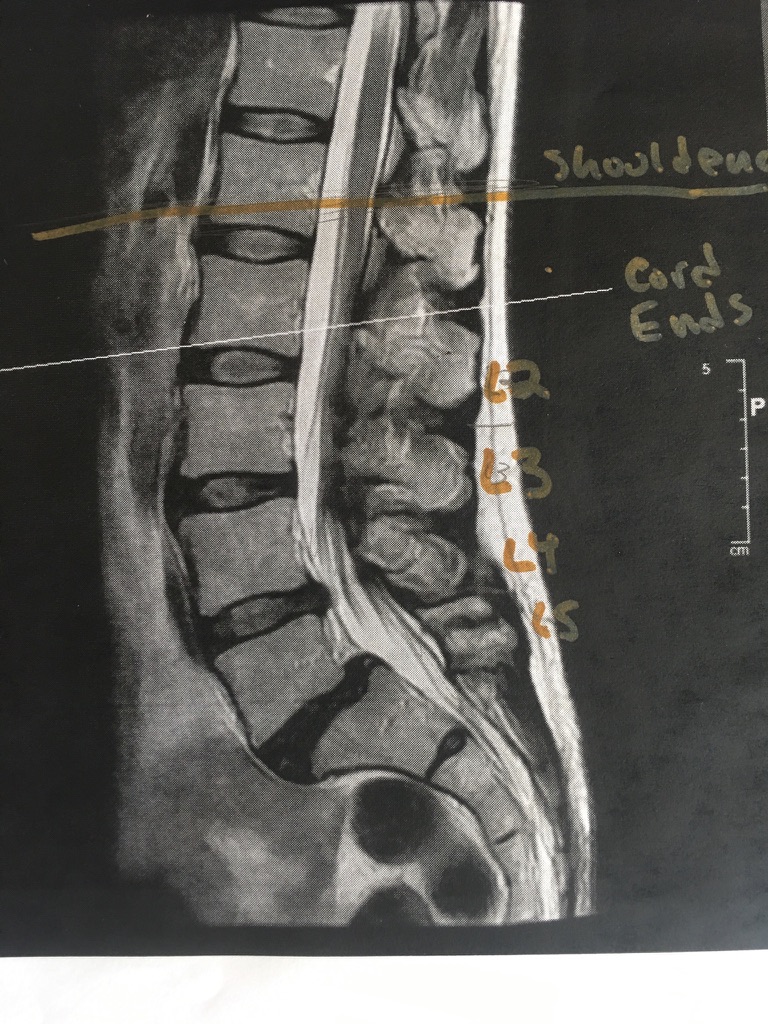
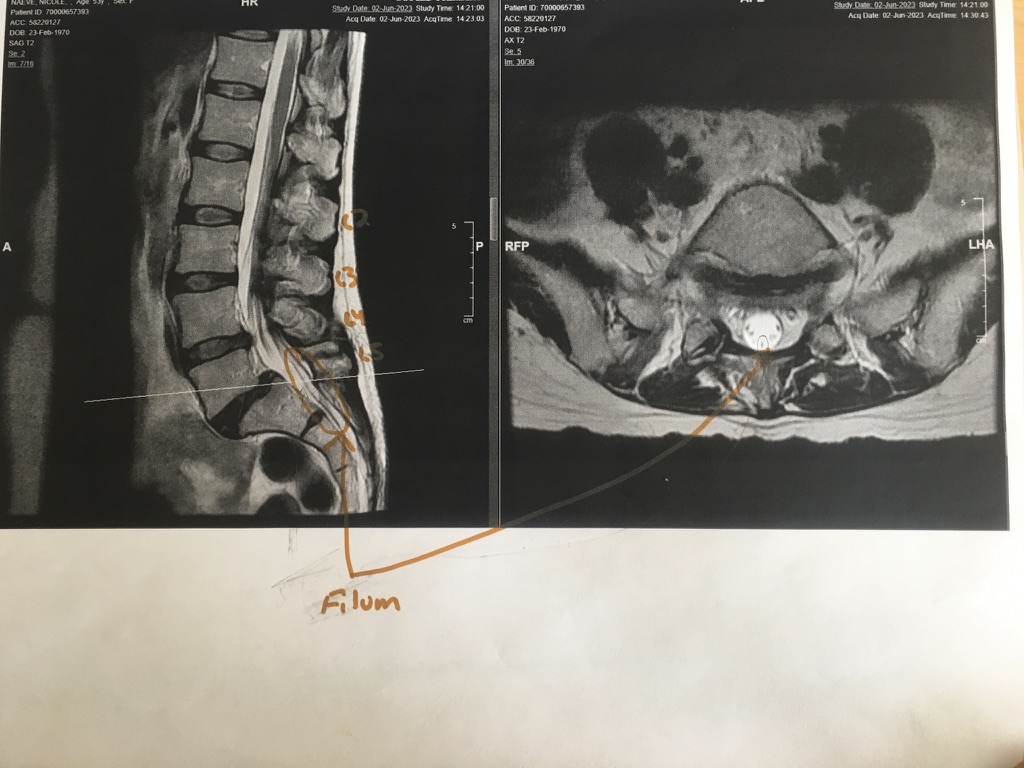
Here Dr. Klinge showed me where normal spinal cords should terminate at the bottom, and where mine ends. (Mine ends lower, because it’s tethered.)
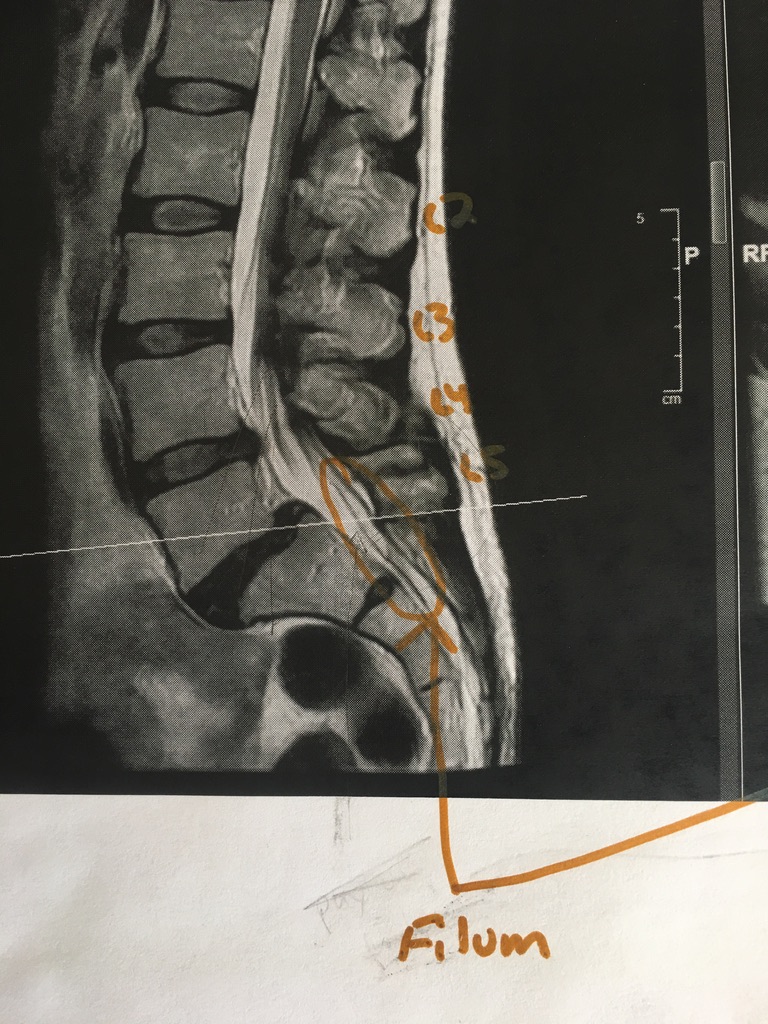
Here the tethered filum is circled.
Several spinal specialists saw this same imaging and did not note this.
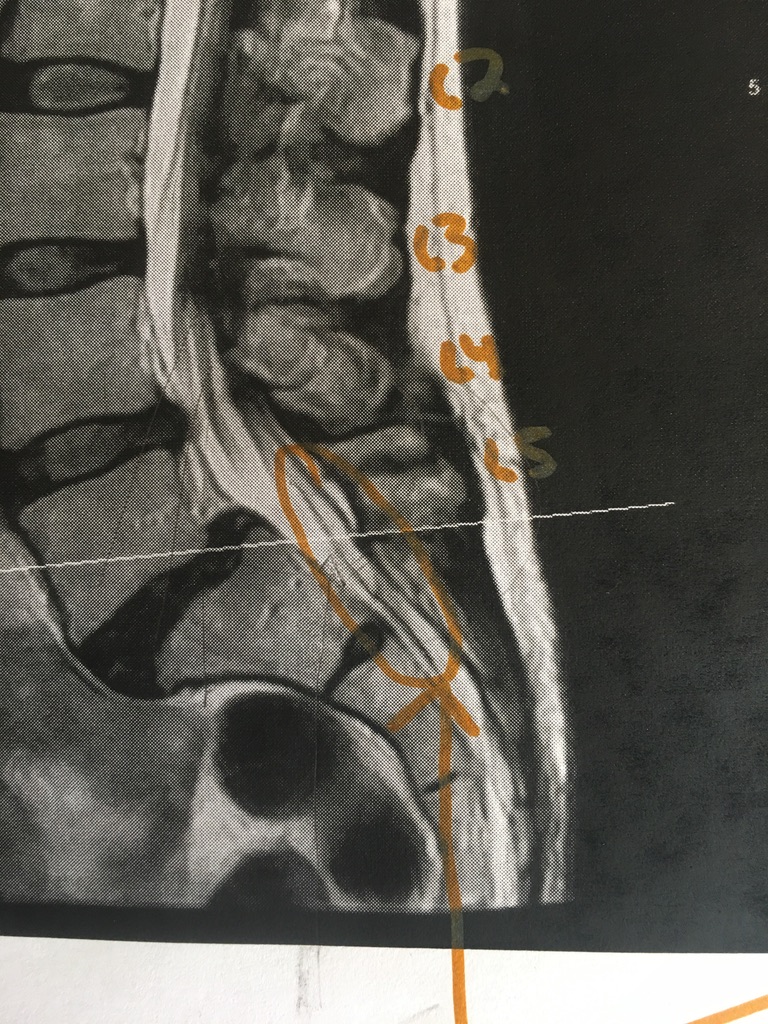
Close-up of the filum. This is what Dr. Klinge cut out and removed. The texture was tough, like grizzled meat, apparently – which is typical of tethered filums.
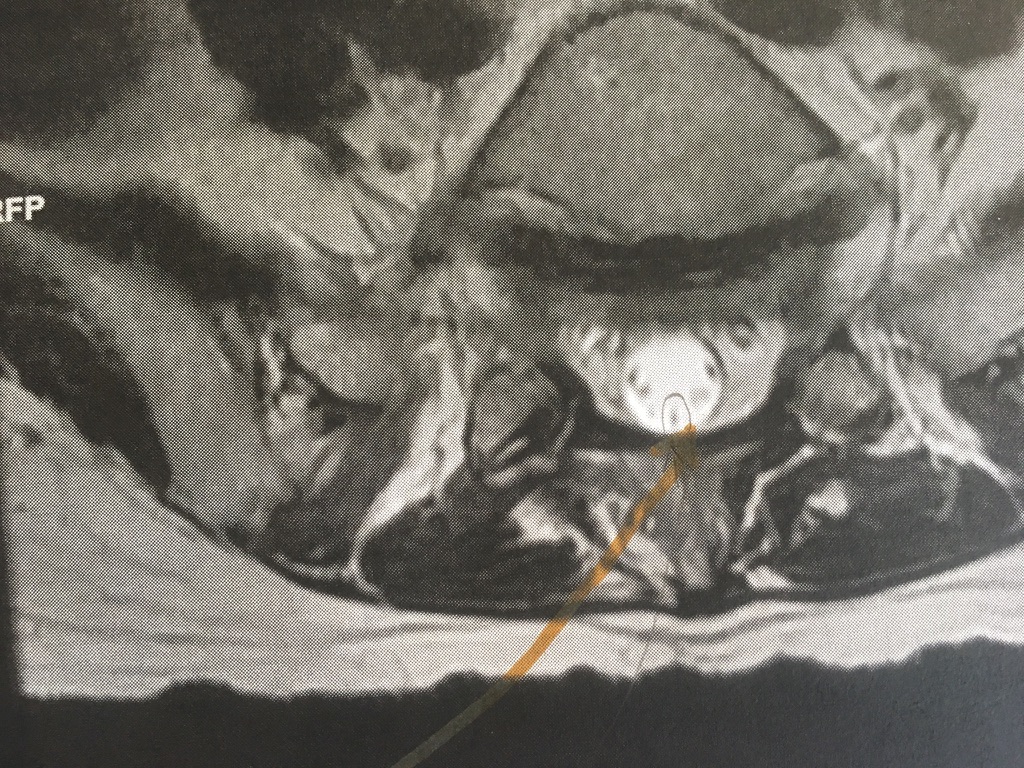
Another view of the tethered filum.


 Niki Naeve
Leave a comment